
What Is Japanese Washi Paper?
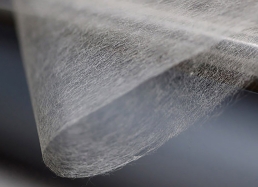
Japanese Washi is one of the world’s most remarkable paper traditions — a material defined not just by history, but by fiber structure, strength, and longevity.
For more than 1,400 years, Washi has been used in sacred texts, official documents, fine art, architecture, and printmaking. Today, it remains one of the most sought-after specialty papers for conservation, design, and high-performance printing.
Washi Paper: History, Manufacture, and Use
Unlike conventional wood-pulp paper, Washi is made from long plant fibers harvested from:
- Kozo
- Mitsumata
- Gampi
These fibers are significantly longer than those found in Western paper. The result is a sheet that is:
- Exceptionally strong
- Remarkably flexible
- Highly absorbent
- Resistant to tearing
- Naturally archival
This fiber structure allows Washi to be incredibly thin while remaining durable — a rare combination that makes it valuable across industries.
Unlike mass-produced papers, traditional Washi can be made to be acid-free and pH neutral, which contributes to its reputation as an archival-grade material suitable for long-term preservation and museum use.
Traditional Washi Production
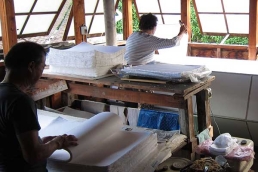
Historically, Washi was made by hand in small workshops during winter months, when cold temperatures provided exceptionally pure water.
The traditional process involved:
- Harvesting and steaming plant bark
- Removing impurities by hand
- Separating fibers through careful beating
- Suspending fibers in water with natural formation agents
- Forming sheets through repeated rocking motions
- Pressing and drying
These methods produced paper of remarkable integrity — many historical Japanese documents remain intact today because they were written on Washi.

The History of Washi
Papermaking techniques were introduced to Japan in the 7th century via Buddhist monks from China and Korea. According to the Nihon Shoki (The Chronicles of Japan, 720 CE), a Korean monk named Doncho helped establish early papermaking techniques in Japan.
Over time, Japanese artisans refined the method — incorporating Kozo and Gampi fibers and developing techniques that emphasized strength, flexibility, and translucency.
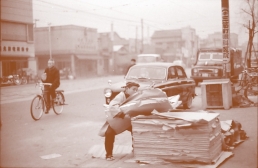
During the Meiji Period (1868–1912), Western-style wood pulp paper replaced Washi for everyday administrative use. However, Washi remained indispensable for artistic, ceremonial, and specialty applications.
Washi In The Modern World
Although Washi originated as a handmade craft, modern innovation has allowed it to evolve without losing its essential qualities.
Today, machine-made Washi can preserve the long-fiber strength and aesthetic character of traditional sheets while offering:
- Consistent thickness
- Scalable production
- Commercial viability
- International distribution
Modern Washi is now used in:
- Archival conservation
- Fine art printing
- Luxury packaging
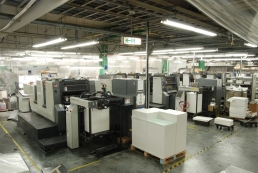
- High-definition offset printing
- Digital printing
- Bookbinding
- Specialty stationery
- Industrial and specialty applications
Because Washi absorbs ink differently than Western paper, it produces exceptional contrast and depth — especially in letterpress and offset printing.


Why Washi Is So Durable
Washi’s durability comes from its fiber length and interwoven structure. Unlike wood pulp paper, which breaks down more quickly due to shorter fibers and chemical processing, properly produced Washi:
- Resists yellowing
- Maintains tensile strength
- Withstands folding
- Performs well in humid environments
This durability is one reason Washi is widely trusted in preservation environments.
Sustainability and Material Integrity
Traditional Washi relies on renewable plant fibers rather than forest wood pulp. Many Washi producers cultivate Kozo and Mitsumata in managed fields rather than harvesting from forests. To address rapidly increasing customers’ demand toward sustainable materials, Washi paper itself is the solution to your sustainable business. Sustainability, chemical control, and fiber integrity remain critical considerations in modern Washi production.

From Cultural Treasure to Global Material
Washi is no longer limited to temples and calligraphy studios. Today, it is a material used by:
- Museums
- Designers
- Printers
- Publishers
- Architects
- Manufacturers
Its rare combination of thinness, strength, and tactile beauty continues to inspire both traditional artisans and modern innovators.
Explore Washi Applications
To see how Washi is used today, explore:
What Is Washi FAQ's
Washi paper is made from natural plant fibers like Kozo, Mitsumata, and Gampi. These fibers are much longer than those used in standard paper, which gives Washi its signature strength, softness, and flexibility.
Yes, many types of Washi are acid-free and pH neutral, making them a great choice for long-term use. Because of its durability and resistance to yellowing, Washi is often used in archival projects, artwork, and important documents.
The strength of Washi comes from its long, interwoven fibers. Even when it’s very thin, those fibers hold together tightly, allowing the paper to resist tearing and wear much better than typical wood-pulp paper.
Yes, traditional Washi paper is an excellent, environmentally sustainable material that can return to the land without becoming waste. It is made from natural, renewable plant fibers; primarily Kozo, Mitsumata, or Gampi, making it fully biodegradable, compostable, and eco-friendly. Its long lifespan also reduces waste over time, supporting more sustainable production and use.