
Why Reversibility Matters in Art Conservation and How Washi Paper Supports Ethical Restoration
When people think about restoration, they often imagine repairing damage and making an object look new again. Professional art conservation, however, follows a very different philosophy. The goal is not to erase history or permanently alter an artifact. Instead, conservators seek to stabilize, preserve, and protect cultural materials while respecting the integrity of the original object.
One of the most important principles guiding modern conservation is reversibility.
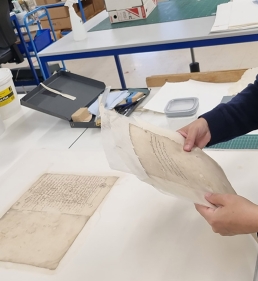
Whether working with historical documents, rare books, maps, prints, photographs, or works of art on paper, conservators strive to use materials and techniques that can be safely removed in the future without causing damage to the original artifact. This approach ensures that future generations can benefit from improved technologies, new research, and evolving conservation methods.
Japanese Washi paper has become one of the most trusted materials in paper conservation because it supports this fundamental principle while offering exceptional strength, flexibility, and longevity.
What Does Reversibility Mean in Conservation?
In conservation, reversibility refers to the ability to remove a repair, treatment, or added material without harming the original object.
Over time, conservation techniques continue to evolve. Materials that were once considered state-of-the-art may later prove unsuitable or may be replaced by superior methods. By using reversible treatments, conservators preserve the option to revisit, adjust, or improve earlier repairs as new knowledge becomes available.
For example, a tear repair completed today may need to be removed decades from now so that additional treatment can be performed. If the repair materials are reversible, the conservator can safely remove them without damaging the original paper.
This philosophy helps protect the long-term integrity of historically significant documents and works of art.
Why Permanent Repairs Are Often Avoided
Many common repair methods used outside of conservation are considered unsuitable for archival materials because they are difficult or impossible to reverse.
Pressure-sensitive tapes, household adhesives, laminating films, and synthetic repair materials often become brittle, discolor over time, or chemically interact with the paper they are intended to protect.
In many cases, these materials cause more damage than the original tear or defect.
Conservators instead choose materials that are:
- Stable over long periods
- Chemically compatible with paper artifacts
- Removable when necessary
- Visually unobtrusive
- Strong enough to support damaged areas without introducing new risks
This is where Japanese Washi paper plays a critical role.
Why Washi Paper Is Ideal for Reversible Conservation
Traditional Japanese Washi paper is handmade from long plant fibers, most commonly Kozo, Mitsumata, or Gampi. Unlike conventional wood-pulp papers, these fibers are exceptionally long, creating a sheet that is both lightweight and remarkably strong.
Because Washi can be produced in extremely thin weights while maintaining impressive tensile strength, it allows conservators to reinforce fragile paper without adding unnecessary bulk.
When paired with conservation-grade adhesives such as wheat starch paste, Washi paper becomes an effective and reversible repair material.
Its unique properties include:
- Exceptional strength relative to weight
- High flexibility
- Long fiber structure
- Archival stability
- Visual compatibility with historic papers
- Ability to be removed during future conservation treatments
These qualities have made Washi a standard material in museums, archives, libraries, and conservation laboratories worldwide.

How Washi Supports Reversible Conservation Treatments
 Tear Mending
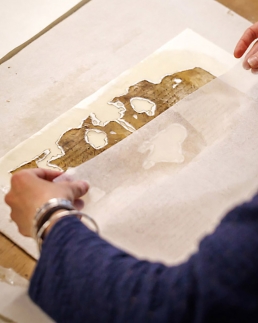
When a document or artwork develops a tear, conservators often use a carefully selected Washi paper to bridge the damaged area.
The repair paper is typically feathered along the edges and adhered using wheat starch paste. This creates a strong repair while minimizing visual impact.
If future treatment becomes necessary, the repair can often be softened and removed without harming the original artifact.
Hinging and Mounting
Delicate works on paper are frequently mounted using Washi hinges rather than permanent adhesives.
A small strip of lightweight Washi is attached to the back of the artwork and secured to an archival support board. This allows the artwork to remain stable while still accommodating natural expansion and contraction caused by changes in humidity.
Most importantly, the washi can later be removed without damage.
Backing and Lining
Fragile maps, manuscripts, and deteriorated documents may require additional structural support.
Thin conservation-grade Washi papers are often applied to the reverse side of an object to reinforce weakened areas. These treatments provide stability while maintaining flexibility and reversibility.
Filling Areas of Loss
When portions of a document are missing, conservators may use carefully selected Washi paper to fill losses and support surrounding areas.
The repair material can be matched to the thickness, texture, and tone of the original artifact while remaining distinguishable upon close examination, an important ethical standard in conservation.
Reversibility and Conservation Ethics
Reversibility is closely connected to another important conservation principle: minimal intervention.
Conservators generally seek to do only what is necessary to stabilize an artifact while preserving as much original material as possible. Treatments should support the object without obscuring its history.
By using reversible materials such as Washi paper and wheat starch paste, conservators can address structural issues while ensuring future professionals retain the ability to reassess and retreat the object if needed.
This approach helps preserve not only the physical artifact but also the historical information it contains.
Why Conservators Continue to Trust Washi Paper
For centuries, Japanese Washi paper has demonstrated exceptional durability and performance. Today, it remains one of the most respected materials in paper conservation because it combines strength, flexibility, and reversibility in ways few other materials can match.
From mending tears and reinforcing brittle documents to creating archival hinges and supporting delicate artworks, Washi paper allows conservators to perform treatments that are effective today while preserving options for the future.
That balance between protection and reversibility is one of the reasons Washi remains an essential material in museums, archives, libraries, and conservation studios around the world.
Explore Conservation-Grade Washi Papers
EdoFiber supplies traditional Japanese Washi papers trusted by conservators, preservation professionals, libraries, archives, and museums. Whether you are evaluating materials for tear repair, hinging, backing, lining, or other conservation treatments, our collection includes ultra-thin and conservation-grade Washi papers designed to support professional restoration practices.