

Filling Losses & Infill Techniques in Paper Conservation
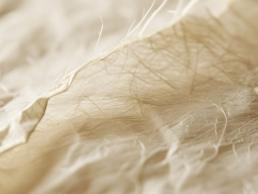
Not all damage to historic documents and works of art on paper involves simple tears. Over time, paper may develop missing corners, holes, insect damage, water deterioration, burn losses, or areas where fibers have completely disappeared. In paper conservation, these missing areas are known as losses.
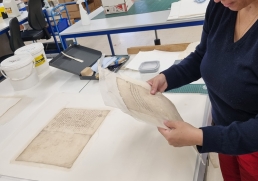
To stabilize damaged objects while preserving their integrity, conservators often use carefully selected Japanese Washi papers to create infill repairs. These repairs restore structural support without attempting to disguise or replace the original artifact.
What Is an Infill Repair?
An infill is a piece of conservation-grade paper that is carefully shaped and inserted into an area where original paper has been lost.
Rather than recreating the missing content or making an object appear “new,” the goal is to restore stability so the document or artwork can be safely handled, stored, exhibited, or studied.
Properly executed infills help distribute stress across damaged areas and prevent additional deterioration.
Common Types of Paper Losses
Historic paper objects can lose material in many ways, including:
- Missing corners
- Torn-out sections
- Insect damage
- Water damage
- Mold deterioration
- Burn holes
- Brittle paper failures
- Mechanical damage from repeated handling
- Previous improper repairs
Each type of loss presents unique conservation challenges and requires careful evaluation before treatment.
Why Japanese Washi Is Ideal for Infill Work
Japanese Washi paper has become one of the preferred materials for infill techniques because it combines exceptional strength with remarkable lightness and flexibility.
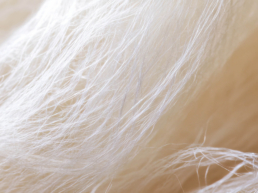
Its long natural fibers allow conservators to create repairs that provide structural support without introducing excessive bulk or stiffness.
Many conservation-grade Washi papers offer:
- Excellent tensile strength
- Lightweight construction
- Acid-free and pH neutral composition
- Long-term stability
- Flexible fiber structure
- Compatibility with reversible conservation adhesives
- A wide range of thicknesses and textures
These characteristics allow conservators to closely match the needs of each individual object.
Selecting the Appropriate Washi Paper
Every conservation treatment is unique. Conservators consider several factors when choosing an infill paper, including:
- Thickness
- Weight
- Fiber composition
- Surface texture
- Color
- Opacity
- Flexibility
- Strength requirements
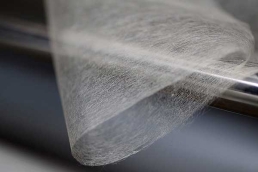
A delicate manuscript may require an ultra-thin Tengujo paper, while a larger map or architectural drawing may benefit from a stronger Kozo paper capable of supporting greater stress.
The objective is always to use the least intrusive material capable of providing the necessary reinforcement.
The Importance of Reversibility
Modern conservation emphasizes treatments that can be reversed or modified in the future if new techniques become available.
Japanese Washi is commonly paired with traditional conservation adhesives such as wheat starch paste because these materials provide secure repairs while preserving future treatment options whenever possible.
This philosophy helps ensure that today’s repair does not become tomorrow’s conservation problem.
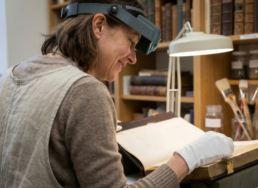

Preserving History, Not Replacing It
A professional infill repair is intended to support the original object rather than recreate missing history.
Conservators generally avoid adding missing text, artwork, or decorative elements unless there is a specific conservation or interpretive reason to do so. Instead, the repair is designed to:
- Restore structural stability
- Reduce stress on damaged areas
- Improve safe handling
- Maintain flexibility
- Respect the authenticity of the original object
- Preserve long-term accessibility
The repair should support the artifact without competing with it.
Applications Beyond Historic Documents
Infill techniques are commonly used on many types of paper-based collections, including:
- Rare books
- Manuscripts
- Maps
- Prints
- Drawings
- Architectural plans
- Certificates
- Family records
- Archival collections
- Works of art on paper
Because these objects often experience different types of deterioration, conservators rely on a variety of Washi papers to achieve the most appropriate repair.
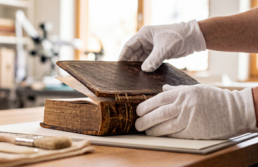
Why Conservators Choose Japanese Washi
For generations, Japanese Washi has been trusted by museums, archives, libraries, and conservation professionals because of its unique balance of strength, flexibility, and longevity.
Its natural fibers, archival qualities, and wide range of weights make it one of the most versatile materials available for stabilizing damaged paper while preserving the historical character of the original object.
Explore Washi Papers for Paper Conservation
Edofiber offers a carefully selected range of traditional Japanese Washi papers suitable for infill repairs, tear mending, structural reinforcement, and other professional conservation treatments.
Contact Edofiber to learn more about available papers, specifications, and sampling options for your paper conservation projects.